Writing a Linux kernel driver for a custom HLS systolic matmul IP
This is Part 5 of the Embedded Linux (Zynq SoC) series. Read Part 1, Part 2: Device Tree, Part 3: Device Tree Overlay and UIO and Part 4: Writing a Linux Platform Driver if you haven’t already.
Table of contents
- Introduction
- How the IP works
- Step 1 - module init and exit
- Step 2 - probe, the device tree and a misc device
- Step 3 - IOCTL register read and write
- Step 4 - DMA buffers and read/write
- Step 5 - interrupts
- Summary
- Glossary
Introduction
In this blog we’ll write our own kernel driver for a custom IP. The IP is a systolic array for matrix multiplication, the same structure used in AI silicon like Google’s TPUs. This one is written in High Level Synthesis (HLS) and is not optimized yet much, because the subject here is the kernel driver rather than the HLS, which will come in a later series.
I won’t drop a whole driver on you and then explain it all in one go. We’ll start with the bare minimum and add one piece of functionality at a time, testing on the board at each step.
The driver has to do four main things:
- Tell the IP where matrix A, B and C live in memory, and how big they are, so it can fetch and write them over its own DMA
- Get the matrix data from userspace and start the multiply
- Wait for the IP to finish without burning CPU cycles, using the interrupt it raises when it is done
- Hand the result back to the userspace application
We’ll get there in five steps, each one building on the last and tested on the board before moving on:
- Module init and exit - the smallest thing that loads and unloads
- probe, the device tree and a misc device - find the IP, map its registers, appear under
/dev/ - IOCTL register read and write - read and write the IP’s registers from an application
- DMA buffers and read/write - move the matrices in and out, and start the multiply
- Interrupts - stop polling and let the process sleep until the IP is done
How the IP works
The IP is a systolic matrix multiplier generated from HLS. It takes two n x n matrices, A and B, and writes the product into C. A and B hold 16 bit signed values, C holds 64 bit signed values so the accumulation has room and does not overflow.
Internally it works on fixed size tiles, so n has to be a multiple of the tile size. That is the only part of the tiling that matters for the driver, and it is why the driver rejects a size that does not fit.
The IP has two kinds of port, and the difference between them is the whole reason this driver looks the way it does:
-
One AXI-Full master.
m_axi_gmem, on the right of thesystolic_matmulIP in the picture below. The IP uses this to fetch A and B and to write C back, on its own, without the CPU. The driver never touches this interface. It only tells the IP which addresses to use. -
One AXI-Lite slave.
s_axi_control, on the left of the same block. This is the register space, and it is the only way the driver talks to the IP.
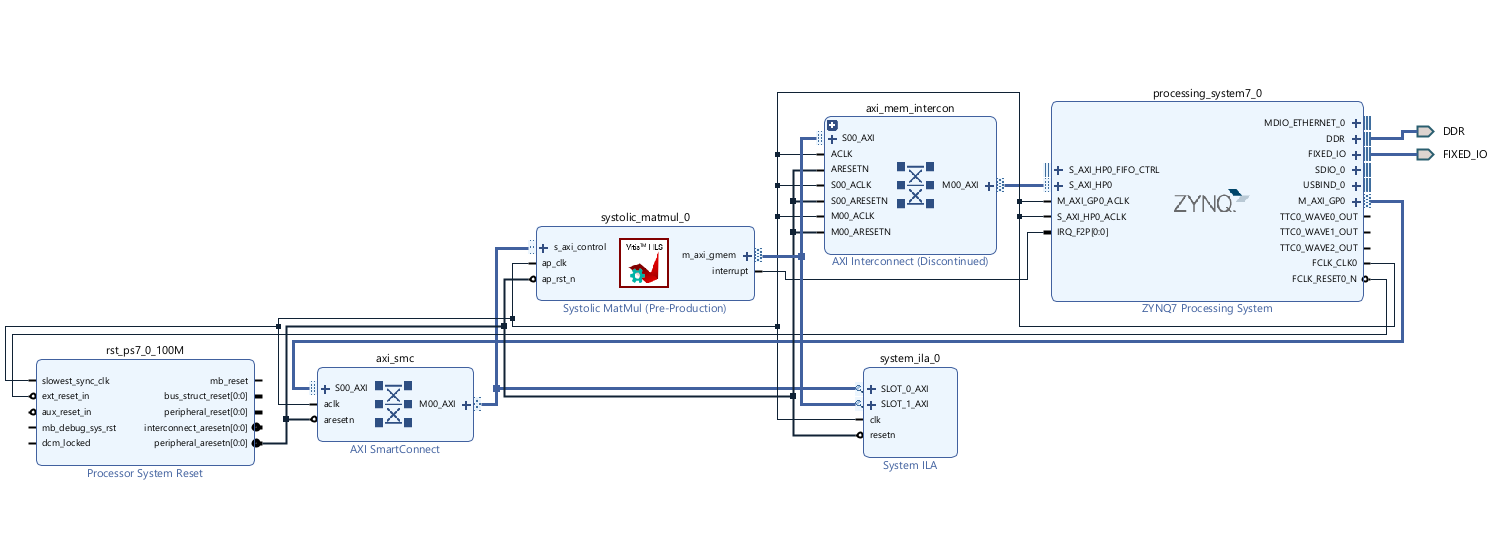 This is the FPGA block design.
 systolic_matmul_0 is our matrix multiplication IP created in HLS. s_axi_control on the left of systolic_matmul_0 is the register interface the driver writes to. m_axi_gmem on the right is the IP’s own master, wired through the interconnect to S_AXI_HP0 so it can reach DDR without the CPU. The interrupt output goes to IRQ_F2P[0:0], which is where the interrupts property in the overlay comes from.
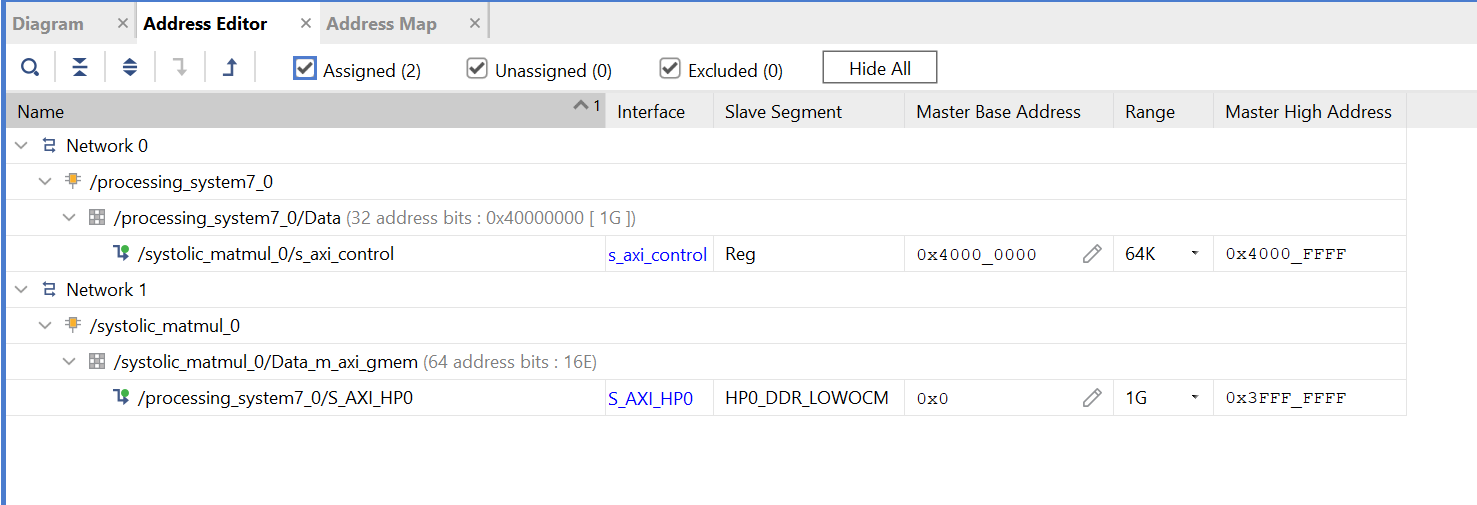 This is the address editor in Vivado.
 s_axi_control is mapped at 0x4000_0000 with a 64K range, which is the reg = <0x40000000 0x10000>; we will see in the device tree overlay. Below it, m_axi_gmem reaches DDR through S_AXI_HP0.
0x4000_0000 is the base of the IP’s register space. These are the registers inside it, with their offsets from that base:
| Offset | Name | What it is for |
|---|---|---|
0x00 |
AP_CTRL | control and status. Bit 0 starts the IP, bit 1 goes high when it has finished and clears as soon as it is read |
0x04 |
GIE | global interrupt enable |
0x08 |
IER | interrupt enable. Bit 0 is the done interrupt |
0x0c |
ISR | interrupt status. Write a 1 back to a bit to clear it |
0x10 |
A | address of matrix A, low 32 bits. High half at 0x14 |
0x1c |
B | address of matrix B, low 32 bits. High half at 0x20 |
0x28 |
C | address of matrix C, low 32 bits. High half at 0x2c |
0x34 |
N | the matrix size n |
The address registers are 64 bit, split across two 32 bit registers each.
So the sequence never changes. Write the three buffer addresses and n, set the start bit, and wait for done. We’ll do that by polling first, and switch to the interrupt in the last step.
Step 1 - module init and exit
To start writing the driver, we first need to create a module template in petalinux. Inside your petalinux directory, run this command:
petalinux-create modules --name <driver-name> --enable
In our case it will be:
petalinux-create modules --name systolic --enable
This will create a folder in recipes-modules with build files and a c file in your petalinux project directory like this:
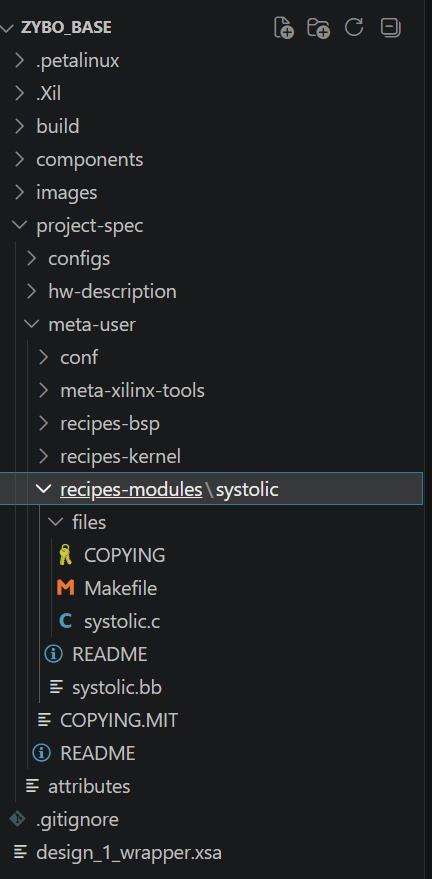
We’ll write our code in systolic.c. You’ll notice that this file already has some default template. its not recommended to use that as it uses older kernel APIs and is not updated for the current kernel used in current Petalinux versions and might cause problems.
We start by the bare minimum driver code:
1
2
3
4
5
6
7
8
9
10
11
12
13
14
15
16
17
18
#include <linux/module.h>
#include <linux/init.h>
#include <linux/kernel.h>

static int systolic_init (void){
    printk("hello from systolic\r\n");
    return 0;
}

static void systolic_exit(void){
    printk("Goodbye from systolic\r\n");
}

module_init(systolic_init);
module_exit(systolic_exit);
MODULE_LICENSE("GPL");
MODULE_DESCRIPTION("Provide interface to systolic IP for fast matmul operation");
MODULE_AUTHOR("Rafae");
This is the simplest kernel driver. Right now the main thing its doing is creating init and exit function and telling kernel to register them as init and exit through moduleinit() and module_exit(). systolic_init() will then be called whenever we load the driver through insmod command, and systolic_exit() will be called whenever we remove the driver through rmmod command.
Declaring the license as GPL means its open source. Which is required to use most of the kernel APIs and features. And descriptions and author are just for module readability.
After writing our code in systolic.c we can build it like:
petalinux-build -c <driver-name>
The <driver-name> should be same as the one you used in petalinux-create command before. So:
petalinux-build -c systolic
This will build the module and will place it in tmp directory in build folder. To find the exact path, use this:
find build/ -name systolic.ko

Copy this on board.
Load driver through insmod command

And remove through rmmod command:

You might notice that we didn’t load any fpga bitstream and overlay. That is because the current driver is not talking to the hardware at all so there’s no need for it. In next step we’ll start talking to the hardware and thus will need both.
Next step is probing the device tree from driver and read the node properties.
Step 2 - probe, the device tree and a misc device
In this section we’ll learn how to actually make the device tree and driver talk with each other and tell the kernel about our IPs existence. The complete code is shown below. The code changes added for this section are highlighted.
1
2
3
4
5
6
7
8
9
10
11
12
13
14
15
16
17
18
19
20
21
22
23
24
25
26
27
28
29
30
31
32
33
34
35
36
37
38
39
40
41
42
43
44
45
46
47
48
49
50
51
52
53
54
55
56
57
58
59
60
61
62
63
64
65
66
67
68
69
70
71
72
73
74
75
76
77
78
79
80
81
82
83
84
85
86
87
88
89
90
91
92
93
94
95
#include <linux/module.h>
#include <linux/init.h>
#include <linux/kernel.h>
#include <linux/of.h>
#include <linux/miscdevice.h>
#include <linux/platform_device.h>
#include <linux/fs.h>
#include <linux/io.h>

#define DRIVER_NAME "systolic"

struct systolic_dev {
    struct miscdevice miscdev;
    void __iomem     *base;
};


static const struct of_device_id systolic_of_match[] = {
    {
        .compatible = "rafae,systolic_driver-1.0",
    },
    {}
};


static const struct file_operations systolic_fops = {
    .owner = THIS_MODULE,
    //empty for now, will be explained later
};


static int systolic_probe(struct platform_device *pdev)
{
    struct systolic_dev *priv;
    int rc;

    priv = devm_kzalloc(&pdev->dev, sizeof(*priv), GFP_KERNEL);
    if (!priv)
        return -ENOMEM;

    priv->base = devm_platform_ioremap_resource(pdev, 0);
    if (IS_ERR(priv->base))
        return PTR_ERR(priv->base);

    priv->miscdev.minor  = MISC_DYNAMIC_MINOR;
    priv->miscdev.name   = "systolic0";
    priv->miscdev.fops   = &systolic_fops;

    rc = misc_register(&priv->miscdev);
    if (rc)
        return rc;

    platform_set_drvdata(pdev, priv);
    dev_info(&pdev->dev, "/dev/%s is ready at base_address = %p\n", priv->miscdev.name, priv->base);
    return 0;
}

static int systolic_remove(struct platform_device *pdev)
{
    struct systolic_dev *priv = platform_get_drvdata(pdev);

    misc_deregister(&priv->miscdev);
    dev_info(&pdev->dev, "removed\n");
    return 0;
}


static struct platform_driver systolic_driver = {
        .probe = systolic_probe,
        .remove = systolic_remove,
        .driver = {
            .name = DRIVER_NAME,
            .of_match_table = systolic_of_match,
    },
};


static int systolic_init (void){
    printk("hello from systolic\r\n");
    return platform_driver_register(&systolic_driver);
}

static void systolic_exit(void){
    printk("Goodbye from systolic\r\n");
    platform_driver_unregister(&systolic_driver);
}

module_init(systolic_init);
module_exit(systolic_exit);
MODULE_LICENSE("GPL");
MODULE_DESCRIPTION("Provide interface to systolic IP for fast matmul operation");
MODULE_AUTHOR("Rafae");
platform_driver struct
Lets start with our first struct. Now, as we want our driver to discover the our IP’s device tree node and read its properties, we need to create a struct of platform_driver type with the relevant information and provide it to the kernel.
This struct contains the information about which function to call to setup the driver to make it available for use from userspace, for example it provides the probe function, which is called once for every device tree node match to set everything up, remove is called to clean up and free up resources when device tree node is removed, .name is whatever name you want to give to your driver and .of_match_table gives the name of struct which contains the compatible string to look for in device tree.
It might seem like probe, remove are doing the same function as systolic_init and systolic_exit. But they run at different level, init and exit runs once when the driver is loaded and removed through insmod and rmmod commands respectively. Whereas probe and remove everytime kernel finds a matching node in device tree. For example for multiple instances of IPs it will run once for each instance.
platform_driver_register / unregister
platform_driver_register() is then used to register the platform_driver struct to the kernel when module_init() is called at insmod. This will make the kernel lookout for any matching device tree nodes. Similarly,
platform_driver_unregister() used to unregister the struct when module_exit is called at rmmod.
of_device_id
This is the struct that contains the compatible string that the kernel will look for in all device tree nodes. This must be the same in both the driver and the device tree.
systolic_dev
Before writing the probe function we need to create our own struct for our IP to retain the data. i.e. pointers provided by kernel in the probe function, because probe function runs only one time per instance, so once it exists, all the local variables in it will be lost. So to retain that information, this struct is used. Probe will fill this and all the other function calls will read it.
Here *base is the pointer that holds the base address provided in reg property in device tree node. Kernel will read the device tree node and probe will save that value here.
Miscdevice is used to create a node for our IP under /dev/ which is then used in userspace application as an interface for the IP.
systolic_probe
Now in the probe function:
devm_kzalloc: is simply memory allocation in kernel space for our systolic_dev struct. K means kernel and z means it will zero our the whole memory.
Then we assign values to this struct:
devm_platform_ioremap_resource: this function will give the base address of our IP read from the reg property in its device tree node and store it in the base pointer in our struct.
For miscdevice, we need to assign some fields:
priv->miscdev.minor: MISC_DYNAMIC_MINOR assigns it a minor number dynamically. For all misc devices the major number is fixed at 10. We can register our device in kernel either as miscdev or cdev. For our use case miscdev is enough as it provides the required functionality and is simpler to setup as compared to cdev.
priv->miscdev.name: This is the name our IP will show as under /dev/
priv->miscdev.fops: This points to the struct file_operations containing mapping between userspace function names and their corresponding functions in the driver. we have not written those functions yet.
misc_register: This adds the device under /dev/
platform_set_drvdata - this will store the local priv pointer into the pdev which is global (per device) and will retain its value even after probe function ends.
dev_info - this will just print a message which the ip name and its base address. keep note that priv->base will be a virtual address so it wont be same as base address in the device tree reg property.
systolic_remove
This will either be called when the exit function is called, once for each of the IP instance or it will be called when this device’s device tree node is removed, for example a new overlay is applied which does not contain this node. In our case it’ll only run once. It removes the device and free up any taken resources.
Device tree overlay
And the corresponding device tree overlay:
1
2
3
4
5
6
7
8
9
10
11
/dts-v1/;
/plugin/;

&amba {
    #address-cells = <1>;
    #size-cells = <1>;
    systolic@40000000{
        compatible = "rafae,systolic_driver-1.0";
        reg = <0x40000000 0x10000>;
    };
};
Compile the .bit.bin and dtbo as mentioned in previous blog and run:

Load device tree overlay:

Running it on the board
Now on board:


Here we can see that our IP is now registered as a node under /dev/. Now this node can be used in our userspace application as an interface to talk to our IP. Right now, think of this node as a door which can now be open and closed. However, there’s no pathway ahead that door through which we can reach our IP. We start creating those roads and pathways next.
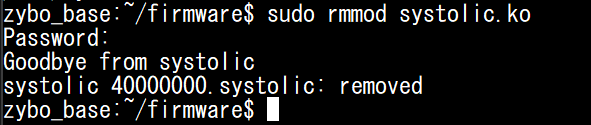
First we remove this loaded driver:
Step 3 - IOCTL register read and write
In this step we’ll add the capability in our driver so we can read and write our IPs registers using a userspace application.
1
2
3
4
5
6
7
8
9
10
11
12
13
14
15
16
17
18
19
20
21
22
23
24
25
26
27
28
29
30
31
32
33
34
35
36
37
38
39
40
41
42
43
44
45
46
47
48
49
50
51
52
53
54
55
56
57
58
59
60
61
62
63
64
65
66
67
68
69
70
71
72
73
74
75
76
77
78
79
80
81
82
83
84
85
86
87
88
89
90
91
92
93
94
95
96
97
98
99
100
101
102
103
104
105
106
107
108
109
110
111
112
113
114
115
116
117
118
119
120
121
122
123
124
125
126
127
128
129
130
131
132
133
134
135
136
137
138
139
140
141
142
143
144
145
146
147
148
149
150
151
152
153
154
155
156
157
158
159
#include <linux/module.h>
#include <linux/init.h>
#include <linux/kernel.h>
#include <linux/of.h>
#include <linux/miscdevice.h>
#include <linux/platform_device.h>
#include <linux/fs.h>
#include <linux/io.h>
#include <linux/iopoll.h>
#include <linux/uaccess.h>


#define DRIVER_NAME "systolic"

#define SYSTOLIC_MAGIC  's'
#define SYSTOLIC_START  _IO (SYSTOLIC_MAGIC, 1)
#define SYSTOLIC_SET_N  _IOW(SYSTOLIC_MAGIC, 2, int)
#define SYSTOLIC_GET_N  _IOR(SYSTOLIC_MAGIC, 3, int)
#define SYSTOLIC_STATUS _IOR(SYSTOLIC_MAGIC, 4, __u32)

#define MAX_N       2048
#define REG_AP_CTRL 0x00
#define REG_N       0x34
#define AP_START    BIT(0)
#define AP_DONE     BIT(1)


struct systolic_dev {
    struct miscdevice miscdev;
    void __iomem     *base;

};


static const struct of_device_id systolic_of_match[] = {
    {
        .compatible = "rafae,systolic_driver-1.0",
    },
    {}
};


static int systolic_open(struct inode *inode, struct file *f)
{
    f->private_data = container_of(f->private_data, struct systolic_dev, miscdev);
    return 0;
}

static int systolic_release(struct inode *inode, struct file *f)
{
    return 0;
}


static long systolic_ioctl(struct file *f, unsigned int cmd, unsigned long arg)
{
    struct systolic_dev *priv = f->private_data;
    u32 val;

    switch (cmd) {
    case SYSTOLIC_SET_N:
        if (get_user(val, (int __user *)arg))
            return -EFAULT;
        if (val < 1 || val > MAX_N)
            return -EINVAL;
        writel(val, priv->base + REG_N);
        return 0;

    case SYSTOLIC_GET_N:
        val = readl(priv->base + REG_N);
        return put_user(val, (int __user *)arg) ? -EFAULT : 0;

    case SYSTOLIC_STATUS:
        val = readl(priv->base + REG_AP_CTRL);
        return put_user(val, (__u32 __user *)arg) ? -EFAULT : 0;

    case SYSTOLIC_START:
        writel(AP_START, priv->base + REG_AP_CTRL);
        return readl_poll_timeout(priv->base + REG_AP_CTRL, val,
                      val & AP_DONE, 10, 1000000);

    default:
        return -ENOTTY;
    }
}

static const struct file_operations systolic_fops = {
    .owner = THIS_MODULE,
    .open           = systolic_open,
    .release        = systolic_release,
    .unlocked_ioctl = systolic_ioctl,
};


static int systolic_probe(struct platform_device *pdev)
{
    struct systolic_dev *priv;
    int rc;

    priv = devm_kzalloc(&pdev->dev, sizeof(*priv), GFP_KERNEL);
    if (!priv)
        return -ENOMEM;

    priv->base = devm_platform_ioremap_resource(pdev, 0);
    if (IS_ERR(priv->base))
        return PTR_ERR(priv->base);

    priv->miscdev.minor  = MISC_DYNAMIC_MINOR;
    priv->miscdev.name   = "systolic0";
    priv->miscdev.fops   = &systolic_fops;

    rc = misc_register(&priv->miscdev);
    if (rc)
        return rc;

    platform_set_drvdata(pdev, priv);
    dev_info(&pdev->dev, "/dev/%s is ready at base_address = %p\n", priv->miscdev.name, priv->base);
    return 0;
}

static int systolic_remove(struct platform_device *pdev)
{
    struct systolic_dev *priv = platform_get_drvdata(pdev);

    misc_deregister(&priv->miscdev);
    dev_info(&pdev->dev, "removed\n");
    return 0;
}


static struct platform_driver systolic_driver = {
        .probe = systolic_probe,
        .remove = systolic_remove,
        .driver = {
            .name = DRIVER_NAME,
            .of_match_table = systolic_of_match,
    },
};


static int systolic_init (void){
    printk("hello from systolic\r\n");
    return platform_driver_register(&systolic_driver);
}

static void systolic_exit(void){
    printk("Goodbye from systolic\r\n");
    platform_driver_unregister(&systolic_driver);
}

module_init(systolic_init);
module_exit(systolic_exit);
MODULE_LICENSE("GPL");
MODULE_DESCRIPTION("Provide interface to systolic IP for fast matmul operation");
MODULE_AUTHOR("Rafae");
Lets see the changes from the start:
IOCTL commands
SYSTOLIC_MAGIC - the magic number is a 8 bit identifier per driver. It should be unique per driver ( kernel won’t throw any error if two drivers have same magic number but its better for error handling). Then 1 2 3 4 are command numbers for each unique ioctl command in this driver. The third is the type of argument passed from or to userspace. IO does not take or pass anything, IOW takes the value to write from userspace, and IOR reads a value back to userspace.
These headers are then called IOCTL commands and can then simply be used to read and write IPs registers from userspace.
SYSTOLIC_START: can be used to start the IP operation.
SYSTOLIC_SET_N can be used to write matrix size N to IP register
SYSTOLIC_GET_N can be used to read matrix size N from IP register
SYSTOLIC_STATUS can be used to read status register from IP.
However, right now these are just IOCTL headers and not doing anything. We use these in the ioctl function. But first a few more headers:
Register offsets
These are the register offsets of the registers in our IP’s register space.
BIT(0) means 1 left shifted by 0 so just 1.
REG_AP_CTRL is the control register and REG_N is the matrix size register. AP_START is BIT(0), so 1 left shifted by 0, just 1. AP_DONE is BIT(1), so 1 left shifted by 1, i.e. 10 in binary, so 2.
systolic_open and systolic_release
In systolic_open we retrieve the pointer to our struct from the kernel that was created in probe function and that we provided to kernel at the end of probe function to preserve it. This is then passed on to other functions like systolic_ioctl as we’ll see below.
systolic_release() is empty because we’re not allocating any new memory in open(), therefore there nothing to clean up in release.
systolic_ioctl
This is the function that will use the IOCTL commands header we defined above and do the actual register read and write.
We first get the pointer to our struct which we retrieved from kernel in systolic_open() above, then we check what the ioctl command is that is called using a switch case. For each command type, if its a command that writes a value, then we use get_user() function to get the value from userspace, and if the command reads a value back to userspace then we use put_user() command to give the value back to userspace.
writel (write long) and readl (read long) are the functions that writes and reads the data to and from the IP registers respectively.
Hardware devices in linux kernel are treated as files. In our IP’s case as well we saw above it appeared as file node /dev/systolic0. So like any file, if we want to talk to it, we need to open it first. And we are done using it, we need to close it. That’s what open and release functions are for.
file_operations struct
We also have to map our function names to the names kernel understand, for this we use the file_operations struct:. Kernel doesnt know about which of these systolic_release(), systolic_open, systolic_ioctl etc to use for which function call from userspace, it know about .open when open() is called in userspace .release when close is called in userspace, .unlocked_ioctl when ioctl() is called in userspace etc. So we tell the kernel using this struct which of our function names maps to the names it understands so it can use them according to their call.
The userspace application
Now we need a userspace application as well to test our added calls in the driver. And check if we can talk to our IP through it.
1
2
3
4
5
6
7
8
9
10
11
12
13
14
15
16
17
18
19
20
21
22
23
24
25
26
27
28
29
30
31
32
33
34
35
36
#include <stdio.h>
#include <stdlib.h>
#include <stdint.h>
#include <fcntl.h>
#include <unistd.h>
#include <sys/ioctl.h>

#define SYSTOLIC_MAGIC   's'
#define SYSTOLIC_START   _IO (SYSTOLIC_MAGIC, 1)
#define SYSTOLIC_SET_N   _IOW(SYSTOLIC_MAGIC, 2, int)
#define SYSTOLIC_GET_N   _IOR(SYSTOLIC_MAGIC, 3, int)
#define SYSTOLIC_STATUS  _IOR(SYSTOLIC_MAGIC, 4, uint32_t)

int main(int argc, char **argv)
{
    int n = (argc > 1) ? atoi(argv[1]) : 64;
    int readback = 0;
    uint32_t status = 0;

    int fd = open("/dev/systolic0", O_RDWR);
    if (fd < 0) {
        printf("cannot open /dev/systolic0\n");
        return 1;
    }

    ioctl(fd, SYSTOLIC_SET_N,  &n);
    ioctl(fd, SYSTOLIC_GET_N,  &readback);
    ioctl(fd, SYSTOLIC_STATUS, &status);

    printf("N written : %d\n", n);
    printf("N read    : %d\n", readback);
    printf("AP_CTRL   : 0x%08x\n", status);

    close(fd);
    return 0;
}
In our case, since we’re writing our own driver we know about the magic number and ioctl command numbers, however, while providing the driver and IP to customer, these will be included in a header file which the user can then just include it and use the ioctl commands without defining these in their application themselves.
As discussed above, hardware devices are treated as files in kernel so we use open to first open our IP’s file node to be able to talk to this. This in turn will call the systolic_open call in our driver and perform the operations defined in it.
Then we use the ioctl command to read and write the registers. This will call to system_ioctl function in our driver and it will read/write the required register according to the passed ioctl command here.
After running the application, we get the following output:

We can view this value being provided to our IP through the AXI-lite interface using ILA.
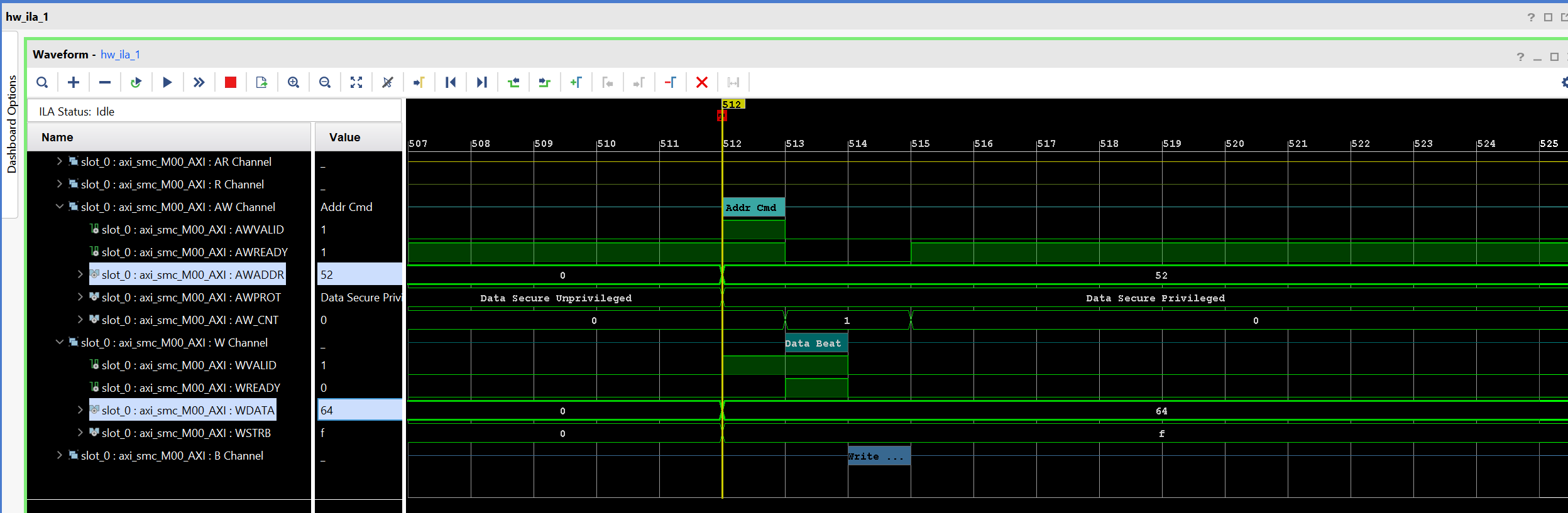
Here AW Channel is the address channel of AXI-lite and W channel is write data channel. we can see that at value 64 is being written at address 52 (decimal, 0x34 in hex) which is the address for register N
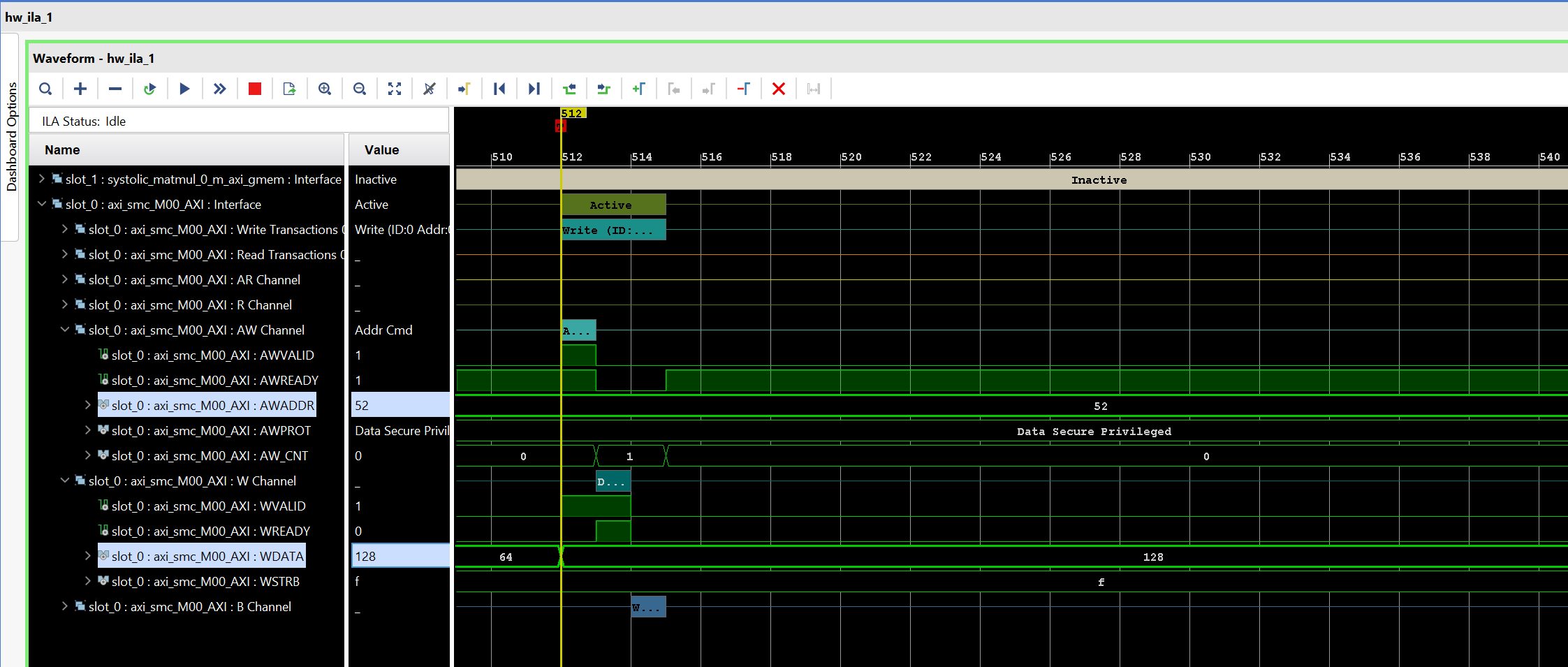
Similarly, if we write value 128 using our userspace application, we can see value 128 being written at address 52 (0x34 in hex)

We can use devmem command as well to verify the value written at the register. devmem is a command which can be used to read/write memory from shell using physical addresses.

Where 0x40000034 is the register address for N.
Step 4 - DMA buffers and read/write
Now we are ready to implement read/write functionality through DMA to provide data to the IP for computation and read it back.
1
2
3
4
5
6
7
8
9
10
11
12
13
14
15
16
17
18
19
20
21
22
23
24
25
26
27
28
29
30
31
32
33
34
35
36
37
38
39
40
41
42
43
44
45
46
47
48
49
50
51
52
53
54
55
56
57
58
59
60
61
62
63
64
65
66
67
68
69
70
71
72
73
74
75
76
77
78
79
80
81
82
83
84
85
86
87
88
89
90
91
92
93
94
95
96
97
98
99
100
101
102
103
104
105
106
107
108
109
110
111
112
113
114
115
116
117
118
119
120
121
122
123
124
125
126
127
128
129
130
131
132
133
134
135
136
137
138
139
140
141
142
143
144
145
146
147
148
149
150
151
152
153
154
155
156
157
158
159
160
161
162
163
164
165
166
167
168
169
170
171
172
173
174
175
176
177
178
179
180
181
182
183
184
185
186
187
188
189
190
191
192
193
194
195
196
197
198
199
200
201
202
203
204
205
206
207
208
209
210
211
212
213
214
215
216
217
218
219
220
221
222
223
224
225
226
227
228
229
230
231
232
233
234
235
236
237
238
239
240
241
242
243
244
245
246
247
248
249
250
251
252
253
254
255
256
257
258
259
260
261
262
263
264
265
266
267
268
269
270
271
272
273
274
275
276
277
278
279
280
281
282
283
284
285
286
287
288
289
290
291
292
293
294
295
296
297
298
299
300
301
302
303
304
305
306
307
308
309
310
311
312
313
314
315
316
317
318
319
320
321
322
323
324
325
326
327
328
329
330
331
332
333
334
335
336
337
338
339
#include <linux/module.h>
#include <linux/init.h>
#include <linux/kernel.h>
#include <linux/of.h>
#include <linux/of_reserved_mem.h>
#include <linux/miscdevice.h>
#include <linux/platform_device.h>
#include <linux/fs.h>
#include <linux/io.h>
#include <linux/iopoll.h>
#include <linux/uaccess.h>
#include <linux/dma-mapping.h>
#include <linux/mutex.h>

#define DRIVER_NAME "systolic"

#define SYSTOLIC_MAGIC  's'
#define SYSTOLIC_START  _IO (SYSTOLIC_MAGIC, 1)
#define SYSTOLIC_SET_N  _IOW(SYSTOLIC_MAGIC, 2, int)
#define SYSTOLIC_GET_N  _IOR(SYSTOLIC_MAGIC, 3, int)
#define SYSTOLIC_STATUS _IOR(SYSTOLIC_MAGIC, 4, __u32)

/* the IP works in 64x64 tiles, so the matrix size must be a multiple of it */
#define TILE_SIZE       64
#define MAX_MATRIX_SIZE     2048

#define AB_BYTES(size)  ((size_t)(size) * (size) * sizeof(s16))
#define C_BYTES(size)   ((size_t)(size) * (size) * sizeof(s64))

#define REG_AP_CTRL 0x00
#define REG_A       0x10
#define REG_B       0x1c
#define REG_C       0x28
#define REG_N       0x34

#define AP_START    BIT(0)
#define AP_DONE     BIT(1)

struct systolic_dev {
    struct miscdevice miscdev;
    struct device    *dev;      // dma_* needs this outside probe
    void __iomem     *base;
    struct mutex      lock;

    int       matrix_size;  // 0 = nothing allocated yet
    s16      *a, *b;
    s64      *c;
    dma_addr_t    a_dma, b_dma, c_dma;
};

// the pointer registers are 64-bit, split across two 32-bit words
static void systolic_set_ptr(struct systolic_dev *priv, u32 reg, dma_addr_t addr)
{
    writel(lower_32_bits(addr), priv->base + reg);
    writel(upper_32_bits(addr), priv->base + reg + 4);
}

static void systolic_free_buffers(struct systolic_dev *priv)
{
    int size = priv->matrix_size;

    if (!size)
        return;

    dma_free_coherent(priv->dev, AB_BYTES(size), priv->a, priv->a_dma);
    dma_free_coherent(priv->dev, AB_BYTES(size), priv->b, priv->b_dma);
    dma_free_coherent(priv->dev, C_BYTES(size),  priv->c, priv->c_dma);

    priv->a = priv->b = NULL;
    priv->c = NULL;
    priv->matrix_size = 0;
}

static int systolic_alloc_buffers(struct systolic_dev *priv, int matrix_size)
{
    size_t ab = AB_BYTES(matrix_size);

    priv->a = dma_alloc_coherent(priv->dev, ab, &priv->a_dma, GFP_KERNEL);
    if (!priv->a)
        return -ENOMEM;

    priv->b = dma_alloc_coherent(priv->dev, ab, &priv->b_dma, GFP_KERNEL);
    if (!priv->b)
        goto free_a;

    priv->c = dma_alloc_coherent(priv->dev, C_BYTES(matrix_size),
                     &priv->c_dma, GFP_KERNEL);
    if (!priv->c)
        goto free_b;

    priv->matrix_size = matrix_size;


    systolic_set_ptr(priv, REG_A, priv->a_dma);
    systolic_set_ptr(priv, REG_B, priv->b_dma);
    systolic_set_ptr(priv, REG_C, priv->c_dma);
    writel(matrix_size, priv->base + REG_N);

    dev_info(priv->dev, "size=%d: a=%pad b=%pad c=%pad\n",
         matrix_size, &priv->a_dma, &priv->b_dma, &priv->c_dma);
    return 0;

free_b:
    dma_free_coherent(priv->dev, ab, priv->b, priv->b_dma);
free_a:
    dma_free_coherent(priv->dev, ab, priv->a, priv->a_dma);
    priv->a = priv->b = NULL;
    return -ENOMEM;
}

static int systolic_open(struct inode *inode, struct file *f)
{
    f->private_data = container_of(f->private_data, struct systolic_dev, miscdev);
    return 0;
}

static int systolic_release(struct inode *inode, struct file *f)
{
    return 0;
}

/* the input region is A followed by B, and the position says which one */
static ssize_t systolic_write(struct file *f, const char __user *buf,
                  size_t count, loff_t *ppos)
{
    struct systolic_dev *priv = f->private_data;
    size_t size;
    void *dst;
    ssize_t rc;

    mutex_lock(&priv->lock);

    if (!priv->matrix_size) {
        rc = -ENXIO;            // if SET_N not called yet
        goto out;
    }

    size = AB_BYTES(priv->matrix_size);

    if (count != size) {
        rc = -EINVAL;
        goto out;
    }

    if (*ppos == 0)
        dst = priv->a;
    else if (*ppos == size)
        dst = priv->b;
    else {
        rc = -EINVAL;
        goto out;
    }

    if (copy_from_user(dst, buf, count)) {
        rc = -EFAULT;
        goto out;
    }

    *ppos = (*ppos == 0) ? size : 0;    // A -> B -> A
    rc = count;
out:
    mutex_unlock(&priv->lock);
    return rc;
}

/* one read returns all of C; there is only one output, so position is unused */
static ssize_t systolic_read(struct file *f, char __user *buf,
                 size_t count, loff_t *ppos)
{
    struct systolic_dev *priv = f->private_data;
    ssize_t rc;

    mutex_lock(&priv->lock);

    if (!priv->matrix_size)
        rc = -ENXIO;
    else if (count != C_BYTES(priv->matrix_size))
        rc = -EINVAL;
    else if (copy_to_user(buf, priv->c, count))
        rc = -EFAULT;
    else
        rc = count;

    mutex_unlock(&priv->lock);
    return rc;
}

static long systolic_ioctl(struct file *f, unsigned int cmd, unsigned long arg)
{
    struct systolic_dev *priv = f->private_data;
    int matrix_size, rc;
    u32 status;

    switch (cmd) {
    case SYSTOLIC_SET_N:
        if (get_user(matrix_size, (int __user *)arg))
            return -EFAULT;
        if (matrix_size < TILE_SIZE ||
            matrix_size > MAX_MATRIX_SIZE ||
            matrix_size % TILE_SIZE)
            return -EINVAL;

        mutex_lock(&priv->lock);
        if (matrix_size == priv->matrix_size) {
            rc = 0;         /* same size, keep the buffers */
        } else {
            // free first
            systolic_free_buffers(priv);
            rc = systolic_alloc_buffers(priv, matrix_size);
        }
        mutex_unlock(&priv->lock);
        return rc;

    case SYSTOLIC_GET_N:
        matrix_size = readl(priv->base + REG_N);
        if (put_user(matrix_size, (int __user *)arg))
            return -EFAULT;
        return 0;

    case SYSTOLIC_STATUS:
        status = readl(priv->base + REG_AP_CTRL);
        if (put_user(status, (__u32 __user *)arg))
            return -EFAULT;
        return 0;

    case SYSTOLIC_START:
        mutex_lock(&priv->lock);
        if (!priv->matrix_size) {
            mutex_unlock(&priv->lock);
            return -ENXIO;
        }
        writel(AP_START, priv->base + REG_AP_CTRL);

        rc = readl_poll_timeout(priv->base + REG_AP_CTRL, status,
                    status & AP_DONE, 1000, 60000000);
        mutex_unlock(&priv->lock);
        return rc;

    default:
        return -ENOTTY;
    }
}

static const struct file_operations systolic_fops = {
    .owner      = THIS_MODULE,
    .open       = systolic_open,
    .release    = systolic_release,
    .read       = systolic_read,
    .write      = systolic_write,
    .unlocked_ioctl = systolic_ioctl,
};

static int systolic_probe(struct platform_device *pdev)
{
    struct systolic_dev *priv;
    int rc;

    priv = devm_kzalloc(&pdev->dev, sizeof(*priv), GFP_KERNEL);
    if (!priv)
        return -ENOMEM;

    priv->dev = &pdev->dev;
    mutex_init(&priv->lock);

    priv->base = devm_platform_ioremap_resource(pdev, 0);
    if (IS_ERR(priv->base))
        return PTR_ERR(priv->base);

    /* attach the memory-region from the device tree, so every
     * dma_alloc_coherent below comes out of our reserved 64 MB
     */
    rc = of_reserved_mem_device_init(&pdev->dev);
    if (rc) {
        dev_err(&pdev->dev, "no usable memory-region (%d)\n", rc);
        return rc;
    }

    priv->miscdev.minor = MISC_DYNAMIC_MINOR;
    priv->miscdev.name  = "systolic0";
    priv->miscdev.fops  = &systolic_fops;
    priv->miscdev.parent    = &pdev->dev;

    rc = misc_register(&priv->miscdev);
    if (rc)
        goto err_rmem;

    platform_set_drvdata(pdev, priv);

    dev_info(&pdev->dev, "ready at %p, buffers allocated on SET_N\n", priv->base);
    return 0;

err_rmem:
    of_reserved_mem_device_release(&pdev->dev);
    return rc;
}

static int systolic_remove(struct platform_device *pdev)
{
    struct systolic_dev *priv = platform_get_drvdata(pdev);

    misc_deregister(&priv->miscdev);
    systolic_free_buffers(priv);
    of_reserved_mem_device_release(&pdev->dev);
    dev_info(&pdev->dev, "removed\n");
    return 0;
}

static const struct of_device_id systolic_of_match[] = {
    {
        .compatible = "rafae,systolic_driver-1.0",
    },
    {}
};

static struct platform_driver systolic_driver = {
    .driver = {
        .name       = DRIVER_NAME,
        .of_match_table = systolic_of_match,
    },
    .probe  = systolic_probe,
    .remove = systolic_remove,
};

static int systolic_init (void){
    printk("hello from systolic\r\n");
    return platform_driver_register(&systolic_driver);
}

static void systolic_exit(void){
    printk("Goodbye from systolic\r\n");
    platform_driver_unregister(&systolic_driver);
}

module_init(systolic_init);
module_exit(systolic_exit);

MODULE_LICENSE("GPL");
MODULE_DESCRIPTION("Provide interface to systolic IP for fast matmul operation");
MODULE_AUTHOR("Rafae");
New headers
TILE_SIZE is the tile size the IP works on, so the matrix size has to be a multiple of it. MAX_MATRIX_SIZE is the largest size we allow. Both are used to reject a bad size before we allocate anything.
AB_BYTES and C_BYTES work out how many bytes a matrix needs for a given size. A and B hold 16 bit values so they use s16, while C holds the accumulated result so it uses s64 and takes four times the memory for the same n.
REG_A, REG_B and REG_C are the register offsets for the buffer addresses for A, B and C matrix. REG_AP_CTRL is the control register we already used in the previous step.
systolic_dev struct
Then we have to update the systolic_dev struct for buffer pointers, mutex lock to handle multiple userspace applications trying to access the IP and dev.
The IP registers need physical addresses for the buffers. But s16 *a *b and s64 *c will provide the virtual addresses. Hence dma_addr_t is used to write map those virtual addresses to physical address and write to the IP registers. mutex lock is used so only one application can access the IP at a time, as our current IP has only one channel.
systolic_set_ptr
systolic_set_ptr - this function is to write the buffer addresses to IP register. So that the IP knows where to read data from for computation and where to write it back. Since the IP takes a 64 bit address divided into two 32 bit register, we have to perform two 32 bit writes on two registers.
systolic_alloc_buffers
systolic_alloc_buffers - we use this function to allocate memory to the buffers a b and c in kernel space a. dma_alloc_coherent is the kernel API that can be used to allocate memory to our buffers from reserved memory region in our device tree (We’ll see the updated device tree for this later in this section)
For each buffer: dma_alloc_coherent - we give the function the dev struct created by kernel (dev contains the information about the reserved memory region this IP can use) and the size, and the function writes the allocated physical address to priv->a_dma and returns the virtual address to priv->a.
After allocating the buffers we provide their pointer to the IP using systolic_set_ptr function. notice that we use priv->a_dma instead of priv->a because the IP needs physical address.
systolic_free_buffers
systolic_free_buffers - we use this function to free up the allocated buffers
systolic_write
First the function takes the mutex lock so no other process can initiate a transfer while one is on going as there is only one IP in the design. Here the read and write is from perspective of userspace application, not the IP.
Since there is only one write path but two different possible destinations (i.e matrix A and B), we need a way to tell the driver which matrix data is currently being written, either A or B. we use ppos for that. ppos is used to tell the current location in file. This really doesn’t have any real meaning here and we’re just using it as a distinguisher, we alternate it between ppos=0 for first matrix and then ppos=size for the second matrix. And using these we set the destination for the incoming data. we use the copy_from_user function to copy the data from userspace memory to kernel space memory.
Note that copy_from_user copies the whole matrix from userspace into the DMA buffer, so the CPU walks over all the data once before the IP even starts. For a big matrix that copy will cost a lot of cycles which is not good. There are better ways to do this but for now to keep it simple we’ll just use this.
systolic_read
for read, its much simpler because we only have one buffer to write.
It just does some error checking, take the mutex lock and then copy the data back to userspace using copy_to_user().
systolic_ioctl
In IOCTL function, the following cases are updated:
SYSTOLIC_SET_N: It checks if the new provided N value from userspace is same as before (if the application has been run before). Then it won’t do anything as the previously allocated buffers can be used again. If the size is different(or if its a first run), then it will first free the previously allocated buffers using systolic_free_buffers and then allocate using systolic_alloc_buffers.
SYSTOLIC_START: It’ll set the start bit of the IP, telling it to start reading data of matrix A and B using the DMA through AXI-Full interface, then we poll the status register to wait for the completion of matrix multiplication.
systolic_probe
We need to make a few changes in probe function as well.
of_reserved_mem_device_init: it connects the memory-region from the device tree to this device, so that every later dma_alloc_coherent on it comes out of your reserved 64 MB instead of the kernel’s general pool. It stores that info in dev, that’s why need to add this to our systolic struct so we can use this dev later for dma operations.
file_operations
In file_operation struct, we have to make two new entries for two added system calls of systolic_read and systolic_write.
systolic_remove
For systolic_remove we deallocate the buffers and release the attached memory region defined in device tree.
Device tree update
dma_alloc_coherent needs a reserved memory region in the device tree. We cannot use kzalloc for reserving this memory as DMA operations usually needs large contiguous buffers. and kzalloc cannot provide large contiguous buffers. So using the device tree we tell the kernel to reserve some memory for DMA buffers and then the kernels DMA APIs can allocate buffers in this region.
However, this memory needs to be reserved at boot time, so we cannot add it in the overlay and will have to add this node in the main device tree which is loaded at boot time. We need to add the following node:
1
2
3
4
5
6
7
8
9
10
11
    reserved-memory {
        #address-cells = <0x01>;
        #size-cells = <0x01>;
        ranges;

        systolic_reserved: systolic@1c000000 {
            compatible = "shared-dma-pool";
            reusable;
            reg = <0x1c000000 0x4000000>;
        };
    };
reg = <0x1c000000 0x4000000>; Defines the starting address of our reserved memory and its size. ranges; with nothing after it means a 1:1 mapping, so an address inside a child node is the same address the CPU uses. But if it were ranges = <0x0 0x1c000000 0x4000000>; instead, a child sitting at 0x0 would really be at 0x1c000000, and every address in that node would be offset by the same amount.
reusable; Means the kernel can use it for other operations as long as we’re not using it, whenever our DMA needs this region, kernel will clear it up and provide this to the DMA.
compatible = "shared-dma-pool"; is used so that the kernel knows its for dma and we can access it through the dma apis in the driver.
We then compile it using following command:
dtc -@ -I dts -O dtb system.dts -o system.dtb
The -@ is used to convert the labels(systolic_reserved here) to symbols like:
systolic_reserved = "/reserved-memory/systolic@1c000000";
Symbols are then used to reference the nodes in main device tree from overlay device tree.
Device tree overlay
In overlay device tree:
1
2
3
4
5
6
7
8
9
10
11
12
/dts-v1/;
/plugin/;

&amba {
    #address-cells = <1>;
    #size-cells = <1>;
    systolic@40000000{
        compatible = "rafae,systolic_driver-1.0";
        reg = <0x40000000 0x10000>;
        memory-region = <&systolic_reserved>;
    };
};
We just add the memory-region node and use the label that we added in the main device tree. This tells the kernel that this node can use that reserved memory region. And we use &systolic_reserved to tell it to reference the node in main device tree that it needs to reference to get info about the reserved memory region.
The userspace application
In the userspace application, we now create matrix A and B. We make B as identity matrix so the output result is simply matrix A and can be checked easily.
1
2
3
4
5
6
7
8
9
10
11
12
13
14
15
16
17
18
19
20
21
22
23
24
25
26
27
28
29
30
31
32
33
34
35
36
37
38
39
40
41
42
43
44
45
46
47
48
49
50
51
52
53
54
55
56
57
58
59
60
61
62
63
64
65
66
67
68
69
70
71
72
#include <stdio.h>
#include <stdlib.h>
#include <stdint.h>
#include <fcntl.h>
#include <unistd.h>
#include <sys/ioctl.h>

#define SYSTOLIC_MAGIC   's'
#define SYSTOLIC_START   _IO (SYSTOLIC_MAGIC, 1)
#define SYSTOLIC_SET_N   _IOW(SYSTOLIC_MAGIC, 2, int)
#define SYSTOLIC_GET_N   _IOR(SYSTOLIC_MAGIC, 3, int)
#define SYSTOLIC_STATUS  _IOR(SYSTOLIC_MAGIC, 4, uint32_t)

int main(int argc, char **argv)
{
    int n = (argc > 1) ? atoi(argv[1]) : 64;
    int readback = 0;
    uint32_t status = 0;
    int i, errors = 0;

    int16_t *a, *b;
    int64_t *c;

    int fd = open("/dev/systolic0", O_RDWR);
    if (fd < 0) {
        printf("cannot open /dev/systolic0\n");
        return 1;
    }

    if (ioctl(fd, SYSTOLIC_SET_N, &n) < 0) {
        printf("size %d rejected (multiple of 64, max 2048)\n", n);
        return 1;
    }

    a = malloc(sizeof(int16_t) * n * n);
    b = malloc(sizeof(int16_t) * n * n);
    c = malloc(sizeof(int64_t) * n * n);

    /* A = counting pattern, B = identity, so C should come back equal to A */
    for (i = 0; i < n * n; i++) {
        a[i] = (int16_t)(i % 100);
        b[i] = (i / n == i % n) ? 1 : 0;
    }

    write(fd, a, sizeof(int16_t) * n * n);      /* -> A */
    write(fd, b, sizeof(int16_t) * n * n);      /* -> B */

    if (ioctl(fd, SYSTOLIC_START) < 0) {
        printf("START failed (timeout?)\n");
        return 1;
    }

    read(fd, c, sizeof(int64_t) * n * n);

    for (i = 0; i < n * n; i++)
        if (c[i] != a[i])
            errors++;

    ioctl(fd, SYSTOLIC_GET_N,  &readback);
    ioctl(fd, SYSTOLIC_STATUS, &status);

    printf("N written : %d\n", n);
    printf("N read    : %d\n", readback);
    printf("AP_CTRL   : 0x%08x\n", status);
    printf("result    : %s (%d mismatches)\n", errors ? "FAIL" : "PASS", errors);

    free(a);
    free(b);
    free(c);
    close(fd);
    return errors ? 1 : 0;
}
We use write function to provide the data for matrix A and B to the driver. This will call the systolic_write function in driver. Then we start the IP and poll to check IP completion. Once done we read the result buffer back in userspace and compare with expected output( which is matrix A in our case)
But how can malloc provide contiguous memory when kzalloc couldn’t, and we had to reserve a region in the device tree for the driver’s buffers?
malloc does not give us physically contiguous memory, and it doesn’t need to. It provides us virtually contiguous memory not physically contiguous, so a[0] to a[n*n-1] are next to each other as far as the application is concerned, while the pages behind them can be scattered anywhere in RAM. That is fine in the application because the application works with virtual memory. But the IP works with physically contiguous memory. So, write() hands the buffer to the driver, the driver copies it into the dma_alloc_coherent buffer, and that one is physically contiguous because it comes out of the region we reserved in the device tree. If we tried to give the IP a malloc pointer directly it would read the wrong memory as soon as the buffer crossed a page boundary.
Now we test on board:

The driver prints the three buffer addresses it allocated, and those are the same values going out on the bus in the capture below. Each address register is 64 bit split across two 32 bit registers, so every buffer takes two writes, low half first:
| Offset | Register | Value written | From the terminal |
|---|---|---|---|
0x10 |
REG_A low |
1c000000 |
a=0x1c000000 |
0x14 |
REG_A high |
00000000 |
|
0x1c |
REG_B low |
1c008000 |
b=0x1c008000 |
0x20 |
REG_B high |
00000000 |
|
0x28 |
REG_C low |
1c020000 |
c=0x1c020000 |
0x2c |
REG_C high |
00000000 |
|
0x34 |
REG_N |
00000080 |
size=128 |
We can see these values being provided to their registers from the addr channel and write data channel in below screenshot.
0x80 is just 128 in hex, which is the size we passed on the command line. All three buffer addresses being written at 0x10, 0x1c, 0x28 fall inside the 0x1c000000 region we reserved in the device tree.
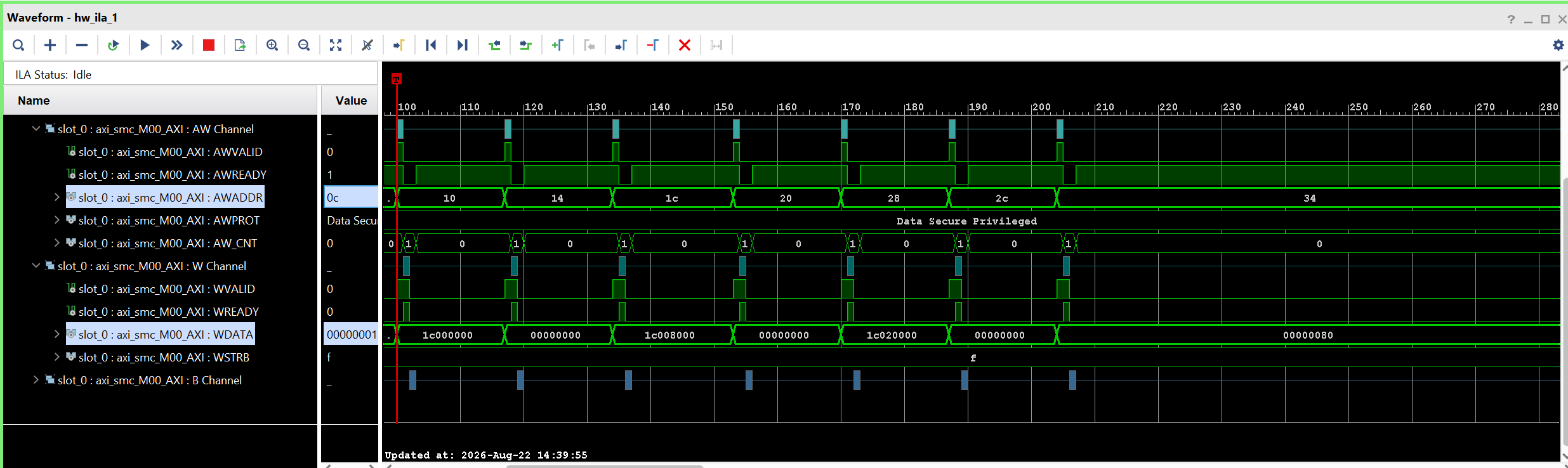
Note: The radix in these ss is hex, where as it the step 3 ss, it was decimal. That’s my bad as I forgot to keep them same when taking the screenshots. The numbers are same just their format is different. So don’t be confused by that.
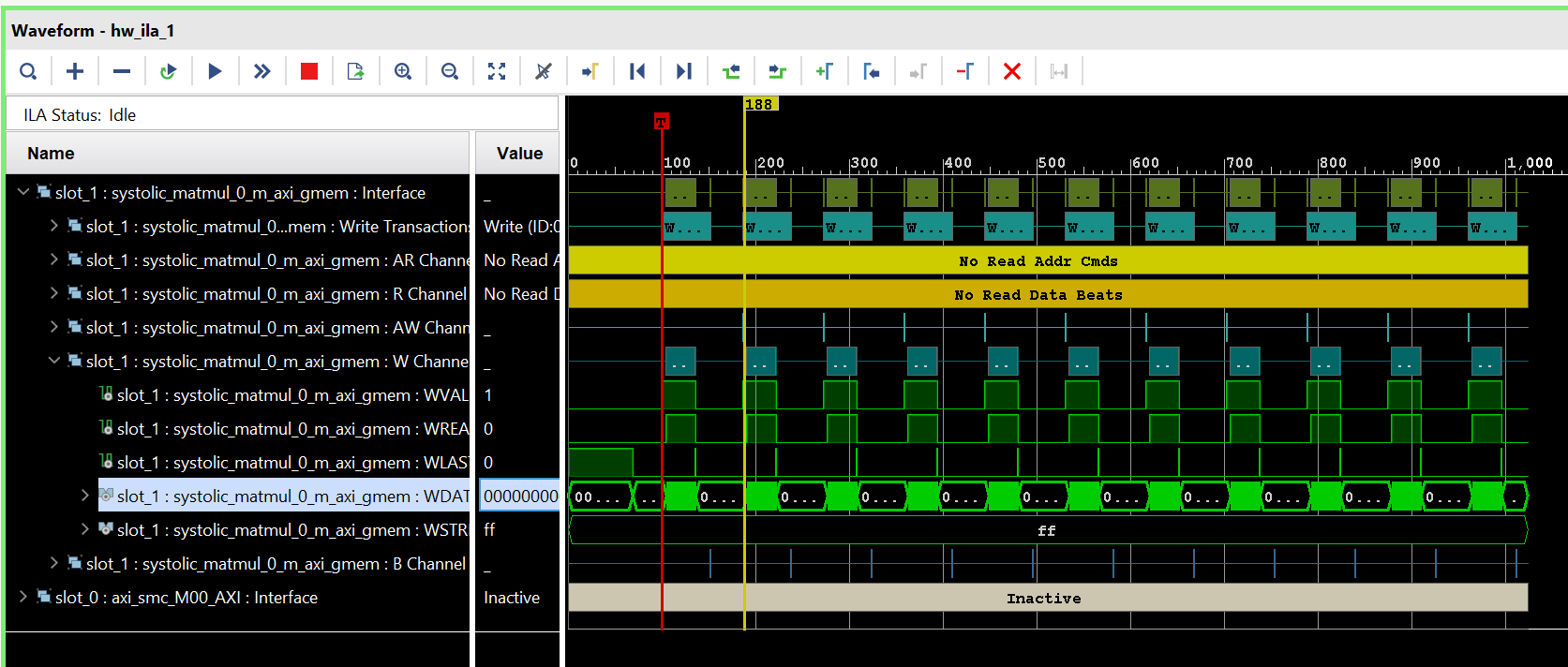
After IP is started, we can see data traffic on the AXI-Full interface. (here only writing back of result is shown).
Step 5 - interrupts
This will be our final step, we will add interrupt handling capability in our driver so we wont have to poll and waste CPU cycles.
1
2
3
4
5
6
7
8
9
10
11
12
13
14
15
16
17
18
19
20
21
22
23
24
25
26
27
28
29
30
31
32
33
34
35
36
37
38
39
40
41
42
43
44
45
46
47
48
49
50
51
52
53
54
55
56
57
58
59
60
61
62
63
64
65
66
67
68
69
70
71
72
73
74
75
76
77
78
79
80
81
82
83
84
85
86
87
88
89
90
91
92
93
94
95
96
97
98
99
100
101
102
103
104
105
106
107
108
109
110
111
112
113
114
115
116
117
118
119
120
121
122
123
124
125
126
127
128
129
130
131
132
133
134
135
136
137
138
139
140
141
142
143
144
145
146
147
148
149
150
151
152
153
154
155
156
157
158
159
160
161
162
163
164
165
166
167
168
169
170
171
172
173
174
175
176
177
178
179
180
181
182
183
184
185
186
187
188
189
190
191
192
193
194
195
196
197
198
199
200
201
202
203
204
205
206
207
208
209
210
211
212
213
214
215
216
217
218
219
220
221
222
223
224
225
226
227
228
229
230
231
232
233
234
235
236
237
238
239
240
241
242
243
244
245
246
247
248
249
250
251
252
253
254
255
256
257
258
259
260
261
262
263
264
265
266
267
268
269
270
271
272
273
274
275
276
277
278
279
280
281
282
283
284
285
286
287
288
289
290
291
292
293
294
295
296
297
298
299
300
301
302
303
304
305
306
307
308
309
310
311
312
313
314
315
316
317
318
319
320
321
322
323
324
325
326
327
328
329
330
331
332
333
334
335
336
337
338
339
340
341
342
343
344
345
346
347
348
349
350
351
352
353
354
355
356
357
358
359
360
361
362
363
364
365
366
367
368
369
370
371
372
373
374
375
376
377
378
379
380
381
382
383
384
#include <linux/module.h>
#include <linux/init.h>
#include <linux/kernel.h>
#include <linux/of.h>
#include <linux/of_reserved_mem.h>
#include <linux/miscdevice.h>
#include <linux/platform_device.h>
#include <linux/fs.h>
#include <linux/io.h>
#include <linux/interrupt.h>
#include <linux/uaccess.h>
#include <linux/dma-mapping.h>
#include <linux/mutex.h>

#define DRIVER_NAME "systolic"

#define SYSTOLIC_MAGIC  's'
#define SYSTOLIC_START  _IO (SYSTOLIC_MAGIC, 1)
#define SYSTOLIC_SET_N  _IOW(SYSTOLIC_MAGIC, 2, int)
#define SYSTOLIC_GET_N  _IOR(SYSTOLIC_MAGIC, 3, int)
#define SYSTOLIC_STATUS _IOR(SYSTOLIC_MAGIC, 4, __u32)

/* the IP works in 64x64 tiles, so the matrix size must be a multiple of it */
#define TILE_SIZE       64
#define MAX_MATRIX_SIZE     2048

#define AB_BYTES(size)  ((size_t)(size) * (size) * sizeof(s16))
#define C_BYTES(size)   ((size_t)(size) * (size) * sizeof(s64))

#define REG_AP_CTRL 0x00
#define REG_GIE     0x04
#define REG_IER     0x08
#define REG_ISR     0x0c
#define REG_A       0x10
#define REG_B       0x1c
#define REG_C       0x28
#define REG_N       0x34

#define AP_START    BIT(0)
#define GIE_ENABLE  BIT(0)
#define IER_AP_DONE BIT(0)
#define ISR_AP_DONE BIT(0)

struct systolic_dev {
    struct miscdevice miscdev;
    struct device    *dev;      // dma_* needs this outside probe
    void __iomem     *base;
    struct mutex      lock;

    wait_queue_head_t wq;       /* read() sleeps here while the IP runs */
    bool          busy;     /* set by START, cleared by the ISR */

    int       matrix_size;  // 0 = nothing allocated yet
    s16      *a, *b;
    s64      *c;
    dma_addr_t    a_dma, b_dma, c_dma;
};

// the pointer registers are 64-bit, split across two 32-bit words
static void systolic_set_ptr(struct systolic_dev *priv, u32 reg, dma_addr_t addr)
{
    writel(lower_32_bits(addr), priv->base + reg);
    writel(upper_32_bits(addr), priv->base + reg + 4);
}

static irqreturn_t systolic_isr(int irq, void *data)
{
    struct systolic_dev *priv = data;

    writel(ISR_AP_DONE, priv->base + REG_ISR);  /* toggle-on-write clears it */
    priv->busy = false;
    wake_up_interruptible(&priv->wq);
    return IRQ_HANDLED;
}

static void systolic_free_buffers(struct systolic_dev *priv)
{
    int size = priv->matrix_size;

    if (!size)
        return;

    dma_free_coherent(priv->dev, AB_BYTES(size), priv->a, priv->a_dma);
    dma_free_coherent(priv->dev, AB_BYTES(size), priv->b, priv->b_dma);
    dma_free_coherent(priv->dev, C_BYTES(size),  priv->c, priv->c_dma);

    priv->a = priv->b = NULL;
    priv->c = NULL;
    priv->matrix_size = 0;
}

static int systolic_alloc_buffers(struct systolic_dev *priv, int matrix_size)
{
    size_t ab = AB_BYTES(matrix_size);

    priv->a = dma_alloc_coherent(priv->dev, ab, &priv->a_dma, GFP_KERNEL);
    if (!priv->a)
        return -ENOMEM;

    priv->b = dma_alloc_coherent(priv->dev, ab, &priv->b_dma, GFP_KERNEL);
    if (!priv->b)
        goto free_a;

    priv->c = dma_alloc_coherent(priv->dev, C_BYTES(matrix_size),
                     &priv->c_dma, GFP_KERNEL);
    if (!priv->c)
        goto free_b;

    priv->matrix_size = matrix_size;


    systolic_set_ptr(priv, REG_A, priv->a_dma);
    systolic_set_ptr(priv, REG_B, priv->b_dma);
    systolic_set_ptr(priv, REG_C, priv->c_dma);
    writel(matrix_size, priv->base + REG_N);

    dev_info(priv->dev, "size=%d: a=%pad b=%pad c=%pad\n",
         matrix_size, &priv->a_dma, &priv->b_dma, &priv->c_dma);
    return 0;

free_b:
    dma_free_coherent(priv->dev, ab, priv->b, priv->b_dma);
free_a:
    dma_free_coherent(priv->dev, ab, priv->a, priv->a_dma);
    priv->a = priv->b = NULL;
    return -ENOMEM;
}

static int systolic_open(struct inode *inode, struct file *f)
{
    f->private_data = container_of(f->private_data, struct systolic_dev, miscdev);
    return 0;
}

static int systolic_release(struct inode *inode, struct file *f)
{
    return 0;
}

/* the input region is A followed by B, and the position says which one */
static ssize_t systolic_write(struct file *f, const char __user *buf,
                  size_t count, loff_t *ppos)
{
    struct systolic_dev *priv = f->private_data;
    size_t size;
    void *dst;
    ssize_t rc;

    mutex_lock(&priv->lock);

    if (!priv->matrix_size) {
        rc = -ENXIO;            // if SET_N not called yet
        goto out;
    }
    if (priv->busy) {
        rc = -EBUSY;            /* the IP is reading these buffers */
        goto out;
    }

    size = AB_BYTES(priv->matrix_size);

    if (count != size) {
        rc = -EINVAL;
        goto out;
    }

    if (*ppos == 0)
        dst = priv->a;
    else if (*ppos == size)
        dst = priv->b;
    else {
        rc = -EINVAL;
        goto out;
    }

    if (copy_from_user(dst, buf, count)) {
        rc = -EFAULT;
        goto out;
    }

    *ppos = (*ppos == 0) ? size : 0;    // A -> B -> A
    rc = count;
out:
    mutex_unlock(&priv->lock);
    return rc;
}

/* waits for the IP, then returns all of C; position is unused */
static ssize_t systolic_read(struct file *f, char __user *buf,
                 size_t count, loff_t *ppos)
{
    struct systolic_dev *priv = f->private_data;
    ssize_t rc;

    /* sleep until the ISR clears busy; returns at once if nothing is running */
    rc = wait_event_interruptible_timeout(priv->wq, !priv->busy, 60 * HZ);
    if (rc == 0)
        return -ETIMEDOUT;
    if (rc < 0)
        return rc;          /* a signal interrupted the wait */

    mutex_lock(&priv->lock);

    if (!priv->matrix_size)
        rc = -ENXIO;
    else if (count != C_BYTES(priv->matrix_size))
        rc = -EINVAL;
    else if (copy_to_user(buf, priv->c, count))
        rc = -EFAULT;
    else
        rc = count;

    mutex_unlock(&priv->lock);
    return rc;
}

static long systolic_ioctl(struct file *f, unsigned int cmd, unsigned long arg)
{
    struct systolic_dev *priv = f->private_data;
    int matrix_size, rc;
    u32 status;

    switch (cmd) {
    case SYSTOLIC_SET_N:
        if (get_user(matrix_size, (int __user *)arg))
            return -EFAULT;
        if (matrix_size < TILE_SIZE ||
            matrix_size > MAX_MATRIX_SIZE ||
            matrix_size % TILE_SIZE)
            return -EINVAL;

        mutex_lock(&priv->lock);
        if (priv->busy) {
            rc = -EBUSY;        /* would free buffers in use */
        } else if (matrix_size == priv->matrix_size) {
            rc = 0;         /* same size, keep the buffers */
        } else {
            // free first
            systolic_free_buffers(priv);
            rc = systolic_alloc_buffers(priv, matrix_size);
        }
        mutex_unlock(&priv->lock);
        return rc;

    case SYSTOLIC_GET_N:
        matrix_size = readl(priv->base + REG_N);
        if (put_user(matrix_size, (int __user *)arg))
            return -EFAULT;
        return 0;

    case SYSTOLIC_STATUS:
        status = readl(priv->base + REG_AP_CTRL);
        if (put_user(status, (__u32 __user *)arg))
            return -EFAULT;
        return 0;

    case SYSTOLIC_START:
        mutex_lock(&priv->lock);
        if (!priv->matrix_size) {
            rc = -ENXIO;
        } else if (priv->busy) {
            rc = -EBUSY;
        } else {
            priv->busy = true;
            writel(AP_START, priv->base + REG_AP_CTRL);
            rc = 0;         /* returns at once; read() waits */
        }
        mutex_unlock(&priv->lock);
        return rc;

    default:
        return -ENOTTY;
    }
}

static const struct file_operations systolic_fops = {
    .owner      = THIS_MODULE,
    .open       = systolic_open,
    .release    = systolic_release,
    .read       = systolic_read,
    .write      = systolic_write,
    .unlocked_ioctl = systolic_ioctl,
};

static int systolic_probe(struct platform_device *pdev)
{
    struct systolic_dev *priv;
    int rc;

    priv = devm_kzalloc(&pdev->dev, sizeof(*priv), GFP_KERNEL);
    if (!priv)
        return -ENOMEM;

    priv->dev = &pdev->dev;
    mutex_init(&priv->lock);
    init_waitqueue_head(&priv->wq);

    priv->base = devm_platform_ioremap_resource(pdev, 0);
    if (IS_ERR(priv->base))
        return PTR_ERR(priv->base);

    /* attach the memory-region from the device tree, so every
     * dma_alloc_coherent below comes out of our reserved 64 MB
     */
    rc = of_reserved_mem_device_init(&pdev->dev);
    if (rc) {
        dev_err(&pdev->dev, "no usable memory-region (%d)\n", rc);
        return rc;
    }

    rc = platform_get_irq(pdev, 0);
    if (rc < 0)
        goto err_rmem;

    rc = devm_request_irq(&pdev->dev, rc, systolic_isr, 0, DRIVER_NAME, priv);
    if (rc)
        goto err_rmem;

    /* both must be set or the IP never raises the line */
    writel(IER_AP_DONE, priv->base + REG_IER);
    writel(GIE_ENABLE,  priv->base + REG_GIE);

    priv->miscdev.minor = MISC_DYNAMIC_MINOR;
    priv->miscdev.name  = "systolic0";
    priv->miscdev.fops  = &systolic_fops;
    priv->miscdev.parent    = &pdev->dev;

    rc = misc_register(&priv->miscdev);
    if (rc)
        goto err_rmem;

    platform_set_drvdata(pdev, priv);

    dev_info(&pdev->dev, "ready at %p, buffers allocated on SET_N\n", priv->base);
    return 0;

err_rmem:
    of_reserved_mem_device_release(&pdev->dev);
    return rc;
}

static int systolic_remove(struct platform_device *pdev)
{
    struct systolic_dev *priv = platform_get_drvdata(pdev);

    misc_deregister(&priv->miscdev);
    systolic_free_buffers(priv);
    of_reserved_mem_device_release(&pdev->dev);
    dev_info(&pdev->dev, "removed\n");
    return 0;
}

static const struct of_device_id systolic_of_match[] = {
    {
        .compatible = "rafae,systolic_driver-1.0",
    },
    {}
};

static struct platform_driver systolic_driver = {
    .driver = {
        .name       = DRIVER_NAME,
        .of_match_table = systolic_of_match,
    },
    .probe  = systolic_probe,
    .remove = systolic_remove,
};

static int systolic_init (void){
    printk("hello from systolic\r\n");
    return platform_driver_register(&systolic_driver);
}

static void systolic_exit(void){
    printk("Goodbye from systolic\r\n");
    platform_driver_unregister(&systolic_driver);
}

module_init(systolic_init);
module_exit(systolic_exit);

MODULE_LICENSE("GPL");
MODULE_DESCRIPTION("Provide interface to systolic IP for fast matmul operation");
MODULE_AUTHOR("Rafae");
New headers
REG_GIE is the global interrupt enable and GIE_ENABLE is the bit that turns it on. REG_IER enables the individual interrupt sources, and IER_AP_DONE is the one for the done signal. REG_ISR is the status register that the handler clears the interrupt bit on, and ISR_AP_DONE is the bit it writes back to acknowledge it. Both the global enable and the source enable have to be set or the IP never raises the line. There are two enable registers because they enable interrupts at different levels: an IP can have multiple interrupts for different events, so IER can be used to enable only the interrupts currently required. This IP has two, done and ready, and we only want done. GIE is a single switch over all of these interrupts and can be used to enable or disable every interrupt from the IP at once.
systolic_dev
busy is a flag that is used to indicate that the IP is currently working. Its 0 when IP is free. And wq is the queue where the process sleeps as we discussed in our previous blog.
systolic_isr
This is the interrupt handler for our interrupt. It just clears the interrupt, sets busy to false and wakes up the sleeping application process.
systolic_ioctl
SYSTOLIC_START: In previous section, when we started the IP in IOCTL function, we also waited there in polling mode to wait for IP to complete its operation.
But now, we just set the start bit, set busy to true, and return.
In SYSTOLIC_SET_N, we check whether busy is already set, and if it is we return without going further. This matters because SET_N is the call that frees the old buffers and allocates new ones, and doing that while the IP is still reading A and B or writing C would hand memory back to the kernel while the hardware is still using it.
systolic_read
In read call we wait for the interrupt, at this point, the application process is asleep and CPU is free to do other tasks.
systolic_write
Similarly to IOCTL, we check if busy is true and if it is then we return without going further.
systolic_probe
In probe function:
We init wq as the wait queue using init_waitqueue_head.
platform_get_irq(pdev, 0) reads the interrupts property off your device tree node, walks it through the controller named by interrupt-parent, and returns the Linux IRQ number.
devm_request_irq register the interrupt handler name that we provide to it i.e. systolic_isr here, with the Linux IRQ number provided by platform_get_irq.
writel then enable the interrupts in IP’s registers.
The userspace application
The only difference from previous section’s application is that now we don’t poll for the IP to complete its operation. The application sleeps in read function. Note that it can be done in a separate poll function call as well as we discussed in previous blog.
1
2
3
4
5
6
7
8
9
10
11
12
13
14
15
16
17
18
19
20
21
22
23
24
25
26
27
28
29
30
31
32
33
34
35
36
37
38
39
40
41
42
43
44
45
46
47
48
49
50
51
52
53
54
55
56
57
58
59
60
61
62
63
64
65
66
67
68
69
70
71
72
#include <stdio.h>
#include <stdlib.h>
#include <stdint.h>
#include <fcntl.h>
#include <unistd.h>
#include <sys/ioctl.h>

#define SYSTOLIC_MAGIC   's'
#define SYSTOLIC_START   _IO (SYSTOLIC_MAGIC, 1)
#define SYSTOLIC_SET_N   _IOW(SYSTOLIC_MAGIC, 2, int)
#define SYSTOLIC_GET_N   _IOR(SYSTOLIC_MAGIC, 3, int)
#define SYSTOLIC_STATUS  _IOR(SYSTOLIC_MAGIC, 4, uint32_t)

int main(int argc, char **argv)
{
    int n = (argc > 1) ? atoi(argv[1]) : 64;
    int readback = 0;
    uint32_t status = 0;
    int i, errors = 0;

    int16_t *a, *b;
    int64_t *c;

    int fd = open("/dev/systolic0", O_RDWR);
    if (fd < 0) {
        printf("cannot open /dev/systolic0\n");
        return 1;
    }

    if (ioctl(fd, SYSTOLIC_SET_N, &n) < 0) {
        printf("size %d rejected\n", n);
        return 1;
    }

    a = malloc(sizeof(int16_t) * n * n);
    b = malloc(sizeof(int16_t) * n * n);
    c = malloc(sizeof(int64_t) * n * n);

    /* A = counting pattern, B = identity, so C should come back equal to A */
    for (i = 0; i < n * n; i++) {
        a[i] = (int16_t)(i % 100);
        b[i] = (i / n == i % n) ? 1 : 0;
    }

    write(fd, a, sizeof(int16_t) * n * n);      /* -> A */
    write(fd, b, sizeof(int16_t) * n * n);      /* -> B */

    if (ioctl(fd, SYSTOLIC_START) < 0) {
        printf("START failed\n");
        return 1;
    }

    read(fd, c, sizeof(int64_t) * n * n);

    for (i = 0; i < n * n; i++)
        if (c[i] != a[i])
            errors++;

    ioctl(fd, SYSTOLIC_GET_N,  &readback);
    ioctl(fd, SYSTOLIC_STATUS, &status);

    printf("N written : %d\n", n);
    printf("N read    : %d\n", readback);
    printf("AP_CTRL   : 0x%08x\n", status);
    printf("result    : %s (%d mismatches)\n", errors ? "FAIL" : "PASS", errors);

    free(a);
    free(b);
    free(c);
    close(fd);
    return errors ? 1 : 0;
}
Device tree overlay
We just add the interrupt number and parent property. These are calculated same as we discussed in device tree overlay blog.
1
2
3
4
5
6
7
8
9
10
11
12
13
14
/dts-v1/;
/plugin/;

&amba {
    #address-cells = <1>;
    #size-cells = <1>;
    systolic@40000000{
        compatible = "rafae,systolic_driver-1.0";
        reg = <0x40000000 0x10000>;
        memory-region = <&systolic_reserved>;
        interrupt-parent = <&intc>;
        interrupts = <0 29 4>;
    };
};
Output:

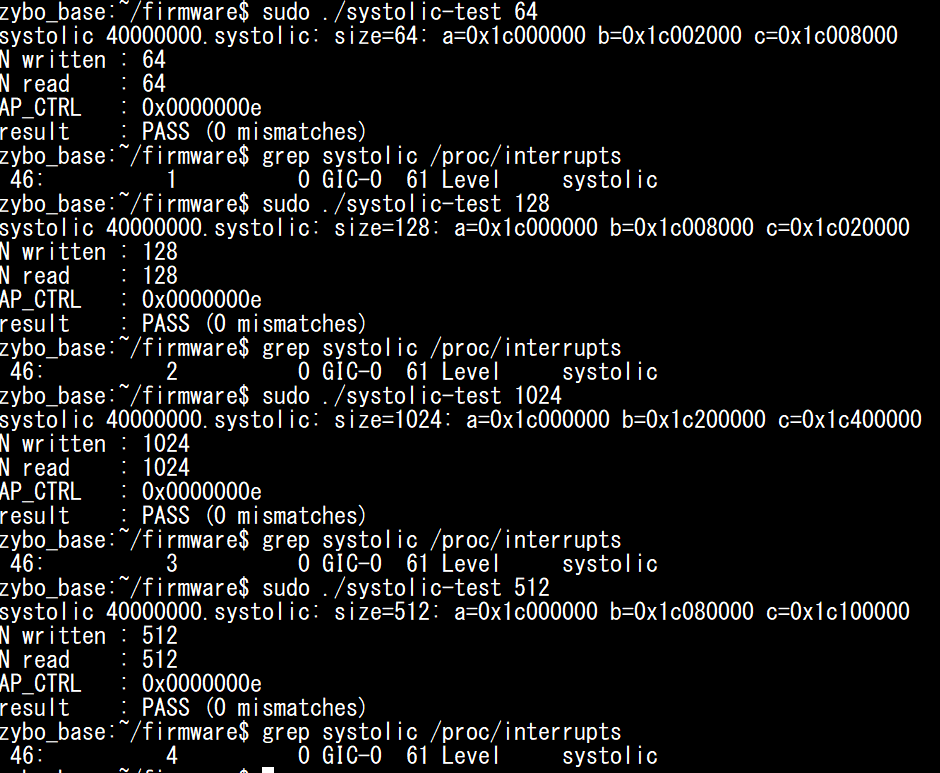
Here you can see that when i check the interrupts occurred for systolic driver after running application, its incremented by once each time. That count is also the first thing to check when it doesn’t work: if the line is missing from /proc/interrupts altogether then that means request_irq never ran and the probe failed, and if it is there but stuck at zero while read() times out then the handler is registered fine and the IP simply is not raising the interrupt, which points at issue in GIE/IER or at the interrupts property in the overlay.
Summary
In this blog we learned about:
-
Module init and exit.
module_initandmodule_exitrun once each, when the module is loaded and unloaded. On their own they know nothing about hardware, which is why this step needed no bitstream and no overlay. -
probe and the device tree. The driver binds to a device tree node through the compatible string and nothing else.
probe()runs on that match, once per matching node, so that is where the registers get mapped and where/dev/systolic0appears. A misc device is the short way to get that node: major 10, dynamic minor. Thedevm_helpers mean the kernel gives back what probe took when the device goes away. -
IOCTL.
file_operationsis the table that landsopen,ioctl,readandwritefrom an application in the driver. ioctl is the right fit for control rather than data: setting n, starting the IP, reading status. -
DMA buffers. The IP fetches and writes the matrices itself, so it needs physical addresses, not the driver’s pointers.
dma_alloc_coherentreturns both at once: a virtual pointer for the CPU and a physical address for the IP’s registers. Those buffers have to be large and physically contiguous, whichkzalloccannot guarantee, so the region is reserved in the device tree at boot. -
Interrupts. Polling the done bit holds the CPU for the whole multiply. An interrupt and a wait queue let the process sleep instead, and the ISR wakes it when the IP is finished.
Glossary: the headers we included
Every header added across the five steps, and the one thing each was needed for.
Driver side
| Header | What we used it for |
|---|---|
<linux/module.h> |
module macros: MODULE_LICENSE, MODULE_AUTHOR, and what makes the file a loadable module. |
<linux/init.h> |
module_init and module_exit, which tell the kernel which functions to call on insmod and rmmod. |
<linux/kernel.h> |
assorted kernel helpers and the printing macros. |
<linux/of.h> |
device tree access, including of_device_id and the compatible matching. |
<linux/miscdevice.h> |
struct miscdevice, misc_register and misc_deregister, which give us the /dev/ node. |
<linux/platform_device.h> |
struct platform_driver, probe and remove, and platform_get_irq. |
<linux/fs.h> |
struct file_operations, the table mapping userspace calls onto driver functions. |
<linux/io.h> |
readl and writel, and devm_platform_ioremap_resource for mapping the registers. |
<linux/iopoll.h> |
readl_poll_timeout, the polling loop used before we moved to interrupts. |
<linux/uaccess.h> |
get_user, put_user, copy_from_user and copy_to_user for crossing the userspace boundary. |
<linux/of_reserved_mem.h> |
of_reserved_mem_device_init, which attaches the reserved region from the device tree to the device. |
<linux/dma-mapping.h> |
dma_alloc_coherent and dma_free_coherent, which allocate memory the IP can reach. |
<linux/mutex.h> |
the mutex that stops two processes starting a transfer at the same time. |
<linux/interrupt.h> |
devm_request_irq, irqreturn_t and the ISR plumbing. |
Userspace application
| Header | What we used it for |
|---|---|
<stdio.h> |
userspace: printf for the test output. |
<stdlib.h> |
userspace: malloc, free and atoi for the matrix buffers and the size argument. |
<stdint.h> |
userspace: the fixed width types the IP’s data is expressed in. |
<fcntl.h> |
userspace: open and its flags. |
<unistd.h> |
userspace: read, write and close. |
<sys/ioctl.h> |
userspace: the ioctl call itself. |
References
- Linux Device Drivers, 3rd edition (LDD3)
- Driver implementer’s API guide
- Misc devices
- Platform devices and drivers
- Device tree usage model in drivers
- DMA API
- Reserved memory bindings
- Vitis HLS: AXI4-Lite and m_axi interfaces
- Zynq-7000 TRM (PL to PS interrupts)
Series: Part 1 · Part 2: Device Tree · Part 3: Device Tree Overlay and UIO · Part 4: Writing a Linux Platform Driver · Part 5